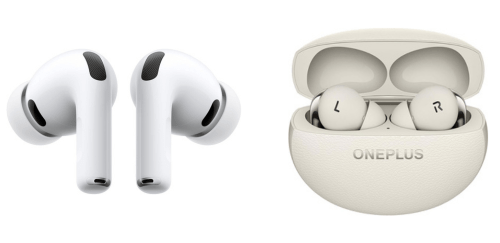
AirPods Pro 3 & OnePlus Buds Pro 3 share many similarities, but there are also important differences, such as quality, performance, features, design, and connectivity. If you want the best one between them, I Would recommend the AirPods Pro 3 rather than the OnePlus Buds Pro 3.
Why Do I Recommend The AirPods Pro 3?
- The AirPods Pro 3 features the Apple H3 chip for faster real-time audio processing, lower latency, and seamless device switching across Apple devices, whereas the OnePlus Buds Pro 3 uses a BES2700 + BES2600 chipset.
- AirPods Pro 3 comes with Adaptive Transparency to reduce sudden loud environmental sounds for safer listening in dynamic environments, whereas the OnePlus Buds Pro 3 uses a fixed transparency mode without automatic loud sound reduction.
- It supports personalized spatial audio with dynamic head tracking calibrated to the user’s ear shape for more accurate 3D sound positioning, while the OnePlus Buds Pro 3 supports spatial audio without personalized ear mapping.
- The AirPods Pro 3 includes a MagSafe and Qi2-compatible charging case for precise magnetic alignment and more stable wireless charging on Apple accessories, whereas the OnePlus Buds Pro 3 supports standard Qi wireless charging without magnetic alignment.
- AirPods Pro 3 includes U2 ultra-wideband tracking for precise location finding with directional guidance through the Find My network, while the OnePlus Buds Pro 3 uses standard Bluetooth-based tracking.
- It features an integrated case speaker for audible alerts and location tracking sounds to help locate the case more easily, while the OnePlus Buds Pro 3 case does not include a built-in speaker.
- The AirPods Pro 3 supports automatic Apple device switching via iCloud for seamless transitions between iPhone, iPad, and Mac without manual reconnection, whereas the OnePlus Buds Pro 3 supports dual-device connection that requires manual switching logic.
- AirPods Pro 3 includes hearing assistance features such as Conversation Boost and adaptive audio adjustments for improved speech clarity in real-world environments, while the OnePlus Buds Pro 3 does not include dedicated hearing enhancement features.
Maybe the OnePlus Buds Pro 3 can make you comfortable because it’s a little bit cheaper than the AirPods Pro 3. But you have to compromise all the above-mentioned features. Now the Decision is Yours. I hope it was helpful to choose the right one.
Side-by-Side Comparison
| Feature | AirPods Pro 3 | OnePlus Buds Pro 3 |
| Chipset | Apple H3 | BES2700 + BES2600 |
| DAC Configuration | Integrated Apple DAC | Dual DAC |
| Active Noise Cancellation | Adaptive ANC | Adaptive ANC up to 50 dB |
| Transparency Mode | Adaptive Transparency | Transparency mode |
| Charging Type | USB-C, MagSafe, Qi2 | USB-C, Qi wireless |
| UWB Chip | U2 chip | Not available |
| Case Speaker | Yes | No |
| Water Resistance | IP57 | IP55, IPX4 |
| Microphones | Beamforming mics | 3 mics + VPU sensor |
| Voice Assistant | Siri | Google Assistant |
| Multi-Device Support | Apple auto-switch | Dual connection |
| Spatial Audio | Personalized + head tracking | Head tracking spatial audio |
| Controls | Force sensor + swipe | Touch gestures |
| Tracking | Precision Finding | No tracking chip |
| Heart Rate Sensor | Yes | No |
| Price | Check AirPods Pro 3 Price | Check OnePlus Buds Pro 3 Price |
What Common Both Can Do?
- Active Noise Cancellation: Both earbuds include active noise cancellation technology that reduces external environmental noise during listening sessions. This helps maintain consistent audio clarity in environments like public transport, offices, or busy streets.
- Transparency Mode: Each model includes a transparency mode that allows ambient sounds to pass through the microphones. This is useful for situations where awareness of surroundings is necessary, such as walking outdoors or having quick conversations.
- Spatial Audio: Both earbuds support spatial audio processing, creating a three-dimensional sound field. This improves immersion when watching movies or listening to multi-channel audio content.
- Bluetooth Connectivity: Both devices use Bluetooth 5.4 for wireless communication with smartphones and other devices. This ensures stable connections, lower latency, and efficient power usage during streaming.
- Wireless Charging: Each charging case supports wireless charging using Qi-compatible pads. This allows users to recharge the case without needing a cable connection.
- USB-C Charging: Both models use a USB-C port for wired charging. This provides compatibility with modern chargers and standardized cables across multiple devices.
- In-Ear Design: Both earbuds feature an in-ear form factor that sits inside the ear canal. This design improves passive noise isolation and helps maintain a secure fit.
- Silicone Ear Tips: Each product includes interchangeable silicone ear tips in multiple sizes. This allows users to adjust fit for comfort and better acoustic sealing.
- Touch Controls: Both earbuds use touch-sensitive surfaces for playback and call control. This enables users to manage audio without interacting directly with their phone.
- Dual Device Connection: Each model supports connection to two devices simultaneously. This allows seamless switching between devices such as a phone and a laptop.
- Voice Assistant Support: Both earbuds integrate with voice assistants like Siri or Google Assistant. This enables hands-free control for tasks like calling, messaging, or setting reminders.
- Fast Charging: Both models include fast charging capability for quick top-ups. A short charging session provides several hours of playback time.
- Noise Reduction for Calls: Each device uses multiple microphones and processing algorithms to reduce background noise during calls. This improves voice clarity for both the user and the listener.
- Companion App Support: Both earbuds connect to a dedicated mobile app for settings customization. Users can adjust controls, update firmware, and manage sound preferences.
- Firmware Updates: Both models support over-the-air firmware updates. This allows performance improvements and new features to be added after purchase.
- IP Water Resistance: Each pair of earbuds includes an IP-rated design for resistance against water and sweat. This makes them suitable for workouts and light exposure to moisture.
- Charging Case Included: Both products include a portable charging case. This extends total battery life and provides safe storage for the earbuds.
- Low Latency Mode: Both earbuds support a low latency mode for improved synchronization between audio and video. This is particularly useful for gaming or video streaming.
- Head Tracking Audio: Each model includes head tracking functionality for spatial audio. This adjusts sound positioning dynamically based on head movement for a more immersive experience.
Common Features
| Feature | AirPods Pro 3 | OnePlus Buds Pro 3 |
| Active Noise Cancellation | Yes | Yes |
| Transparency Mode | Yes | Yes |
| Spatial Audio | Yes | Yes |
| Bluetooth Connectivity | Bluetooth 5.4 | Bluetooth 5.4 |
| Wireless Charging | Yes | Yes |
| USB-C Charging | Yes | Yes |
| In-Ear Design | Yes | Yes |
| Silicone Ear Tips | Yes | Yes |
| Touch Controls | Yes | Yes |
| Dual Device Connection | Yes | Yes |
| Voice Assistant Support | Yes | Yes |
| Fast Charging | Yes | Yes |
| Noise Reduction for Calls | Yes | Yes |
| Companion App Support | Yes | Yes |
| Firmware Updates | Yes | Yes |
| IP Water Resistance | Yes | Yes |
| Charging Case Included | Yes | Yes |
| Low Latency Mode | Yes | Yes |
| Head Tracking Audio | Yes | Yes |
| Price | Check AirPods Pro 3 Price | Check OnePlus Buds Pro 3 Price |
FAQ
Do both earbuds support active noise cancellation? Which earbuds have better sound quality? Do AirPods Pro 3 and OnePlus Buds Pro 3 support spatial audio? Which model has longer battery life? Do both earbuds support wireless charging? Can both connect to multiple devices at the same time? Which earbuds are better for Apple users? Which earbuds are better for Android users? Do both earbuds have water resistance? Do these earbuds support fast charging? Can you track both earbuds if they are lost? Do both earbuds support voice assistants? Are the controls customizable on both models? Do both earbuds receive software updates? |